Why a human‑first chatbot may be hurting your small business
Introduction – what the study shows
A recent Consumentenbond study asked more than 10,000 Dutch consumers about their experience with chatbots (an automated chat tool that answers common questions). The result is striking: almost 90 % say chatbots make it harder to talk to a real employee, and seven out of ten get no answer at all.
For a small bakery, a local dentist, or a boutique logistics firm, that isn’t just an annoyance – it can mean lost sales, bad reviews, and even a breach of Dutch law that requires a visible phone number and e‑mail address on every business website.
The hard truth behind the numbers
| Result | Impact on your business |
|---|---|
| 90 % negative perception | Customers already start with a bias against your brand before they even type a question. |
| 70 % receive no answer from the bot | A missed answer is a missed sale. |
| 35 % cannot save the chat transcript | Customers can’t refer back to advice, making follow‑up harder and increasing frustration. |
| Large retailers also fail the test | Even big names like Albert Heijn or Coolblue struggle, so the problem isn’t “only small shops”. |
When a visitor can’t get a quick, helpful reply, they either abandon the site or turn to a competitor who offers a human touch. In the age of online ordering and instant booking, that loss can be immediate and measurable.
Why a human‑first chatbot still wins for small businesses
A chatbot can handle simple, repetitive questions – “What are your opening hours?” or “Do you accept iDEAL?”. But when the conversation moves beyond scripted answers, people expect a live person.
Providing an obvious, easy way to reach a human does three things:
- Preserves trust – customers feel heard and valued.
- Protects revenue – a quick hand‑off prevents abandoned carts.
- Keeps you compliant – Since May 2022 the Dutch Telecommunications Act requires every business website to display a clearly visible phone number and e‑mail address.
Practical steps you can take today
A human‑first chatbot starts with contact details that are impossible to miss.
- Make contact details impossible to miss for your human‑first chatbot by placing a phone number and e‑mail address in the header or footer, using a larger font and a contrasting colour. Add a “Call us” button on mobile that dials directly.
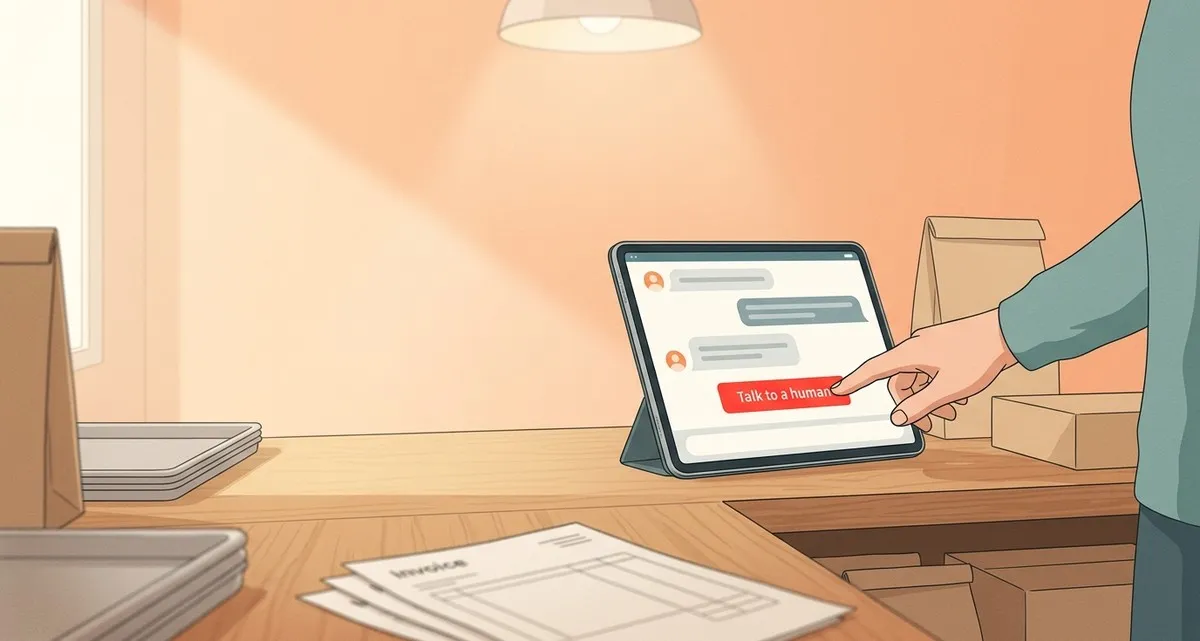
- Add a “Talk to a human” button to your human‑first chatbot inside the chat window, including a persistent link or button that instantly routes the visitor to a live‑chat operator or phone line. Label it clearly, e.g., “Need help? Talk to a human”.
- Set up fallback routing in your human‑first chatbot so that after two unanswered questions it automatically escalates to a live agent. This prevents the visitor from looping through the same canned responses.
- Deploy a simple live‑chat widget alongside your human‑first chatbot that shows the operator’s name and a real‑time typing indicator. Even a handful of minutes of live support each day can dramatically improve conversion rates.
- Create a short FAQ for your human‑first chatbot identifying the top three questions your customers ask (e.g., “What are your opening hours?”, “Do you deliver?”, “How can I change an order?”). Write concise answers and feed them to the bot. Keep the list short – the bot’s strength is speed, not depth.
FAQ – quick answers for busy owners
Q: I don’t have the budget for a live‑chat agent. Can I still comply?
A: Yes. A “Talk to a human” button can route visitors to a phone line, and a simple FAQ covers most routine queries. You can start with a part‑time agent or outsource the calls during peak hours.
Q: My website already shows a phone number, but it’s buried in the footer. Is that enough?
A: The law requires the contact details to be “logically placed and easy to find”. Move the phone number to the top navigation or a sticky header so visitors see it within two clicks.
Q: How do I know if my chatbot is actually helping or hurting?
A: Track two metrics: the percentage of chats that end with a human hand‑off, and the conversion rate of visitors who used the chat. If more than 30 % need a hand‑off, you likely need to improve the bot or add more human support.
Q: What is a human‑first chatbot?
A: A human‑first chatbot is an automated chat tool that answers common questions but always offers a clear, easy way to reach a real person when the visitor needs more help.
Human‑First Chat Review – let us help you get it right
At IT Move NL we understand that technology should work for you, not become a barrier. Our Human‑First Chat Review looks at your current chatbot, adds a clear “Talk to a human” button, sets up fallback routing, and can install a lightweight live‑chat widget or phone integration.
We combine our AI & Automation expertise with ongoing Maintenance & Support, so the solution stays reliable and compliant without you needing to become a tech expert.
Ready to keep sales flowing and customers happy?
Contact us for a short, no‑obligation audit and see how a human‑first approach can boost your business today.
Sources:

He/Him · AWS Certified Solutions Architect | Cloud Engineer @ Essent
Cloud Engineer at Essent B.V. with 10+ years of experience in the tech industry. AWS Certified, passionate about serverless architectures, Infrastructure as Code, and DevOps. Proficient in TypeScript, Python, and Terraform. Based in Amersfoort, Netherlands.
STAY IN THE LOOP
// Cloud, AI & DevOps insights — straight to your inbox.
No spam. Unsubscribe anytime.
// Related articles



Need help with your cloud infrastructure?
Our team of experts is ready to help you navigate the complexities of modern cloud architecture.
Get in Touch