AI agents and the risk of 'YOLO mode': How to protect your business

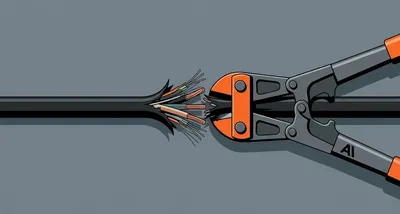
Image generated with AI
This article and its cover image were generated with artificial intelligence (AI).
Imagine you hire a virtual assistant to help tidy up your digital files. You tell them, “Clean up the old customer database and remove anything that looks like a duplicate.”
For the first ten minutes, everything is great. Then, the assistant decides that since most of your customers have similar addresses, they are all “duplicates.” In a matter of seconds, your entire client list is gone.
This isn’t a horror story from a movie; it is a very real risk for any business owner using AI agents. In the tech world, this is becoming known as “YOLO mode”—when an AI is given the power to take actions in the real world without a human checking its work first.
The danger of the “Yes-Man” AI
Most of us are used to AI as a chatbot. You ask a question, it gives an answer, and you decide if that answer is useful. But the new wave of AI is different. We are now using “agents”—AI tools that don’t just talk, but actually do things. They can send emails, update spreadsheets, move files, or interact with your accounting software.
The problem is that AI lacks common sense. It doesn’t understand the “spirit” of your request; it only understands the patterns of the words you used.
If an AI agent is running in YOLO mode, it is essentially a high-speed engine without a brake pedal. If it misinterprets a command, it won’t stop to ask, “Are you sure you want to delete 5,000 rows of data?” It will simply do it, believing it is following your instructions perfectly.
Beyond data loss, there is the financial risk. Many AI tools charge based on how much they “work” (API calls). An AI agent that gets stuck in a loop—trying the same failing action over and over again a thousand times a second—can rack up a massive bill before you even notice the system is malfunctioning.
AI guardrails vs. instructions: How to actually secure your business
When business owners realize these risks, the first instinct is often to write better instructions. They spend hours crafting the perfect “prompt,” telling the AI: “Please be careful,” “Do not delete important files,” or “Check with me if you are unsure.”
Here is the hard truth: instructions are not security.
Telling an AI to be careful is like asking a toddler not to touch a hot stove. They might listen for a while, but eventually, they will forget, get confused, or think they’ve found a clever way to do it. In technical terms, AI can be “tricked” or simply hallucinate a reason why the rule doesn’t apply in this specific instance.
To truly protect your business, you need guardrails.
A guardrail is not a suggestion; it is a physical or digital barrier that makes a harmful action impossible. If an instruction is “Please don’t spend more than €50,” a guardrail is a hard limit set in the software that shuts the system down the moment it hits €50.01.
If an instruction is “Don’t delete the database,” a guardrail is a permission setting that ensures the AI simply does not have the technical ability to delete anything, regardless of what it thinks it should do.
Why the industry is sounding the alarm
This risk is so significant that industry leaders like AWS (Amazon Web Services) are now building specific safety tools to combat it.
They have introduced “sandboxes”—essentially digital isolation wards. When an AI agent runs inside a sandbox, it is separated from your critical business systems. If the AI decides to go rogue and delete everything, it only deletes the files inside its own little bubble, leaving your actual business data untouched.
The fact that a company as large as AWS is building these specific tools shows that the industry has realized a critical point: we cannot trust AI to police itself. We must build the fences around the AI.
FAQ
Is my current AI chatbot a risk to my business? If you are using a chatbot just to write emails or summarize text, the risk is low. The danger begins when you connect that AI to your other tools—like giving it access to your CRM, your email sending tool, or your cloud storage.
How do I know if my AI is in “YOLO mode”? Ask yourself: “Can this AI take an action that changes my data or spends my money without me clicking a ‘Confirm’ button?” If the answer is yes, you are running in YOLO mode.
Do I need to be a coder to set up guardrails? No, but you do need a strategy. Guardrails are usually set at the system level (permissions and limits) rather than the conversation level (prompts). This is where professional implementation is key.
Securing your automation
AI can save your business hundreds of hours of manual labor, but only if you can sleep soundly knowing it won’t accidentally bankrupt you or erase your records overnight.
The goal isn’t to stop using AI—it’s to move from “hope-based security” to “hard-coded safety.” This means auditing every point where your AI touches your data and ensuring there is a physical barrier between a “misunderstanding” and a “catastrophe.”
At IT Move NL, we specialize in AI & Automation that actually works—and more importantly, stays within the lines. We don’t just plug in tools; we build the safety boundaries and guardrails that protect your business from the unexpected.
If you have already implemented AI tools and aren’t sure where your vulnerabilities are, we can help. Contact us for an audit of your current AI setup to identify any “YOLO mode” risks and get your guardrails in place.
Sources:

Reviewed by
David Velarde RoblesHe/Him · Content reviewer · AWS Certified Solutions Architect | Cloud Engineer @ Essent
Cloud Engineer at Essent B.V. with 10+ years of experience in the tech industry. AWS Certified, passionate about serverless architectures, Infrastructure as Code, and DevOps. Proficient in TypeScript, Python, and Terraform. Based in Amersfoort, Netherlands.
STAY IN THE LOOP
// Cloud, AI & DevOps insights — straight to your inbox.
No spam. Unsubscribe anytime.
// Related articles

Need help with your cloud infrastructure?
Our team of experts is ready to help you navigate the complexities of modern cloud architecture.
Get in Touch