Your Meta Business account may have just given away the keys to your website
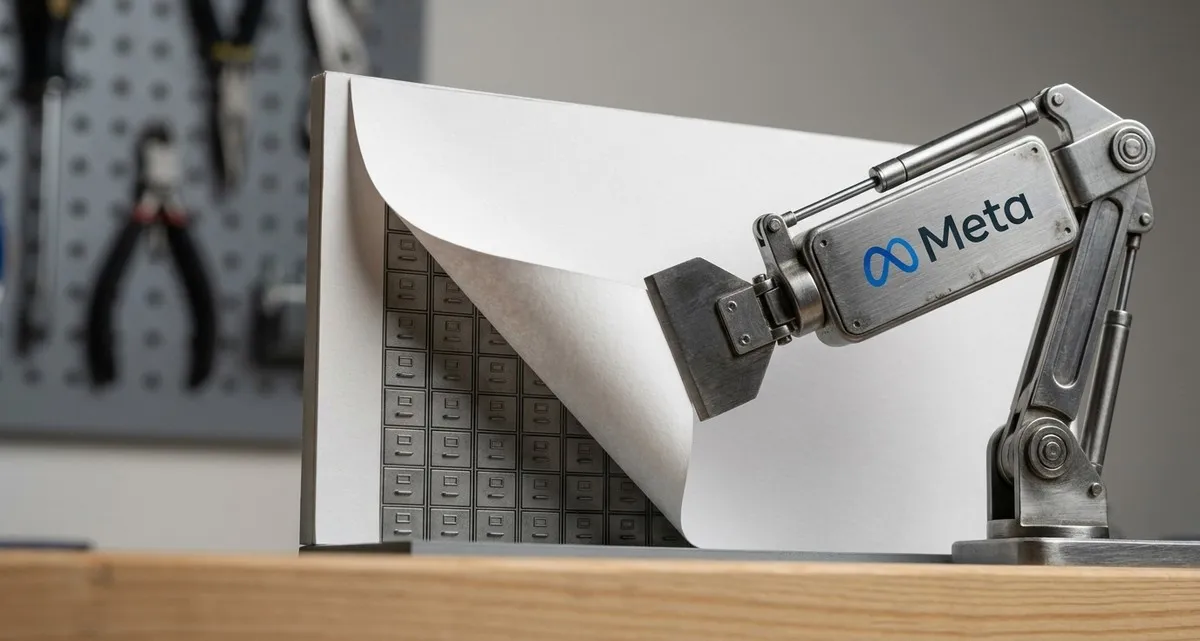
Image generated with AI
This article and its cover image were generated with artificial intelligence (AI).
If you use Facebook or Instagram to promote your business, you likely use the Meta Business Suite. It is a convenient, free dashboard that lets you schedule posts, manage messages, and track how your ads are performing. But “free” tools in the digital world rarely cost nothing; usually, the price is paid in data.
Recent industry reports and legal experts have highlighted a significant change in Meta’s commercial terms. Starting October 30, the company is updating its rules regarding how it accesses the websites associated with these business accounts.
In short: by continuing to use a Meta Business account, you are granting the company permission to use automated tools to “scrape” your website to train its AI models.
What is web-scraping, exactly?
To a business owner, “scraping” might sound like something that happens to a knee, but in tech, it is a method of data collection.
Web-scraping is the use of automated software—often called bots, crawlers, or spiders—to visit a website and “read” everything on the page. Instead of a human clicking through your site to find a price list, a bot can scan thousands of pages in seconds, copying the text, images, and structure into a database.
Meta is now explicitly stating that they can use these bots to index and analyze the domains and URLs associated with your business products. This data is then used to “provide, develop, improve, research, and train” their AI services.
Why this matters for your business
For many, this feels like a technicality, but it is actually a transfer of a digital asset. Your website contains your proprietary way of doing business—your pricing strategies, your unique service descriptions, and your curated content.
Imagine a dental clinic that has spent years writing detailed guides on patient care to attract new clients, or a bakery with a unique, carefully worded description of its artisanal process. When Meta scrapes this data, that specialized knowledge is absorbed into an AI model. The AI isn’t “stealing” your website in the sense that your site disappears, but it is using your intellectual effort to make its own tools smarter. If a potential customer asks a Meta AI tool about a specific dental procedure, the AI might provide an answer based on the exact expertise the clinic published, without the customer ever needing to visit the clinic’s website.
The “no opt-out” reality
The most critical part of this update is the lack of a choice. According to legal experts, there is no opt-out mechanism for this specific term.
If you want to keep using the Meta Business Suite to manage your Instagram and Facebook presence, you must accept these terms. If you disagree, the only real alternative is to stop using the platform’s business tools entirely. For most small businesses, that is not a viable option, as it would mean losing their primary way of reaching customers.
This highlights a recurring lesson in modern business: Terms and Conditions are not just legal boilerplate. They are the contracts that determine who owns your data and how it can be used once it leaves your server.
How to protect your digital presence
While you cannot opt out of Meta’s terms if you stay on their platform, you can still take steps to control how the rest of the internet—and other AI bots—interact with your website.
One of the first lines of defense is a robots.txt file. This is a simple text file on your server that acts like a “No Entry” sign for certain bots. While some aggressive scrapers ignore it, many reputable bots follow these instructions. You can configure your site to tell specific AI crawlers that they are not welcome to index your content.
Beyond that, security monitoring is essential. You should know when your site is experiencing an unusual surge in traffic from automated bots. If a bot is scraping your site too aggressively, it can slow down your page load speeds for real customers, which hurts your search engine ranking and your user experience.
FAQ
Does this mean Meta can see my private business files? No. This specifically refers to “web-scraping,” which means the bots are looking at the public-facing parts of your website and the URLs you link to in your business profile. They cannot access your private internal documents unless those documents are publicly hosted on your website.
Will my website disappear from Google search results? No. This is different from search engine indexing. Meta is collecting data to train AI, not to replace the way Google finds your business. However, the goal of AI is often to provide the answer directly to the user, which can sometimes reduce the number of people who actually click through to your website.
Can I stop Meta from scraping my site but keep my Facebook page? Based on the new terms, if you use the Meta Business Suite (the dashboard for managing your business presence), you are consenting to these terms. There is currently no way to use the business tools while opting out of the scraping.
Take control of your data
It is easy to feel powerless when a global platform changes the rules, but you don’t have to leave your digital doors wide open. The goal is to balance the marketing benefits of social media with the protection of your business’s intellectual property.
At IT Move NL, we help business owners implement the technical safeguards necessary to keep their data secure. Whether it is optimizing your robots.txt configurations or setting up professional security monitoring to see who is accessing your site and why, we ensure your technology works for you—not the other way around.
If you are unsure where your data might be leaking or want to know if your website is properly shielded from aggressive AI bots, we can help. Contact us for a comprehensive security audit to identify your vulnerabilities and put the control back in your hands.
Sources:
- Have a Meta business account? You’re consenting to AI scraping now, legal experts say
- Meta grants itself right to scrape content from business customers for model training
- Meta draait AI-model met 816 miljard parameters op twee Macs
- Twee Mac Studio’s met M5 Ultra kunnen Meta’s Muse Spark Open-model draaien

Reviewed by
David Velarde RoblesHe/Him · Content reviewer · AWS Certified Solutions Architect | Cloud Engineer @ Essent
Cloud Engineer at Essent B.V. with 10+ years of experience in the tech industry. AWS Certified, passionate about serverless architectures, Infrastructure as Code, and DevOps. Proficient in TypeScript, Python, and Terraform. Based in Amersfoort, Netherlands.
STAY IN THE LOOP
// Cloud, AI & DevOps insights — straight to your inbox.
No spam. Unsubscribe anytime.
// Related articles


Need help with your cloud infrastructure?
Our team of experts is ready to help you navigate the complexities of modern cloud architecture.
Get in Touch